When we first landed in Kathmandu, we were surprised by the order and relative cleanliness of the streets. We’re staying in the touristy Thamel neighborhood, surrounded by creature comforts like bakeries with fresh warm cinnamon buns, espresso machines, burrito cafes, Irish bars, live bands playing Bob Marley and the Beatles, and plentiful wifi internet. The streets in Thamel are dust-free, and there’s no trash in the gutters, no animal dung to step over. Not surprisingly, it turns out that this is definitely an artificial oasis of calm surrounded by the “real” Kathmandu, which we explored on foot on our first day back in the city after returning from our week in the mountains.
In fact, the real Kathmandu is quite possibly the dustiest, most chaotic city we’ve ever been in, and the old town looks more ancient and crumbling than anywhere I’ve ever seen. I loved it! Though dodging the motorbikes and rickshaws, navigating the crowds, and avoiding the women armed with brooms who were whipping up the dust on their thresholds into noxious clouds quickly sapped our energy. We frequently ducked into alleyways or courtyards to momentarily evade the chaos.

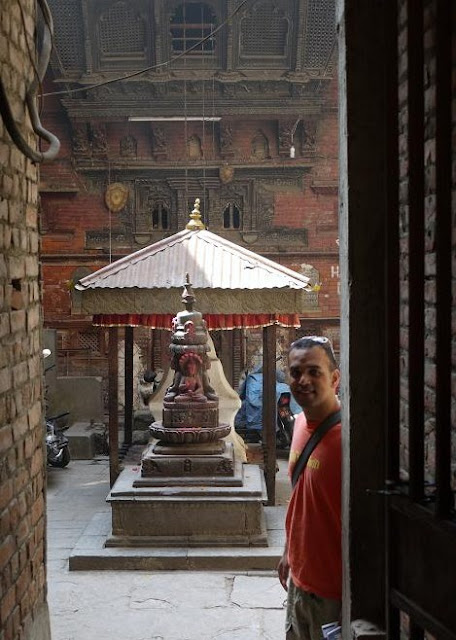


The buildings in the old town look like they’ve been lived in for a thousand years- and some of them probably have. The stone walls are cracked and bowed and leaning precariously, and the ornate wooden balconies that were probably elegant at one time now look dangerously possible of crumbling. And these buildings are all still energetically occupied, with bustling markets at the ground floors and laundry hanging from the old windows on the upper floors. People must have been half as tall when these buildings were built, because the ancient rows of dilapidated old wooden doors that swing open at ground level to reveal dark caves of shops are about four feet tall; they look live shops for dwarves. Or maybe hobbits.

We wandered into Kathmandu’s Durbar Square, the former seat of the city’s kings, where the royal palace is surrounded by a hodgepodge of tiered Hindu and Buddhist temples built mostly between 1100 and 1700. In the unyielding midday sun (the blue of the sky turned white by the thick air pollution), we mingled with tourists from all over the world, though the tourists seem to be well outnumbered by the millions of pigeons.

I suspect the two dreadlocked men who sidled up to Mohit aren’t really holy men, and that they’ve donned their costumes for the rupees that they beg off tourists like us who take photographs of them. After I snapped the photo, the taller one bumped fists with me, Obama-style.
The Nepali people seem to have a very casual relationship with religion. In the shade of the thousand-year old temples in Durbar Square and on every street corner throughout the city, drunks lay sprawled out to sleep away the afternoon, and men gather to argue and gossip. One of the temples we visited is dedicated to a Hindu god that also doubles as a Buddhist icon. The street levels of many temples are occupied by shops selling mundane everyday goods like plastic buckets and shampoo; at others, the stairs are draped with pashmina shawls and yak wool blankets for sale.
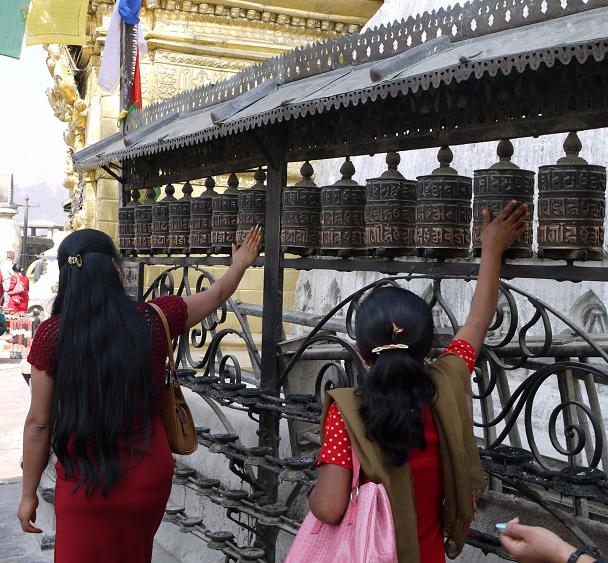
And yet, people still pause as they pass to honor the gods, putting their palms together, bowing their heads, reaching up to ring the brass bells, and scattering some red powder or marigold petals on the stone carvings of the gods.


I’m struggling to understand the complex political turmoil in this country. The former prime minister Girija Prasad Koirala died on Saturday, and the whole city ground to a halt as a national holiday was declared. From our taxi window, we could hear the roar of a crowd assembled in the cricket stadium, and I saw hundreds of people in line in a field nearby. We learned later that they were all gathered to pay their respects to Koirala, who had been appointed, overthrown and reinstated multiple times during his long political career, spent time in prison, and then led the 2006 revolt to overthrow Nepal‘s former authoritarian king. The men working at our hotel camped out in the lobby glued to the television all day and into the night, watching repetitive coverage of his life and last rites.

And yet we have been reading about the rampant corruption of government in Nepal. As in India, bribery is common and expected. We witnessed the strength of the challenging Maoist uprising in the neighboring city of Patan, where a throng of people marched through the streets waving flags bearing the symbol of socialism and shouting loudly. When we were hiking through mountain villages, we saw Maoist graffiti on the stone walls of homes; apparently the Maoists draw their strength from the poorest villages of western Nepal, where rural people are fed up with being overlooked and cheated by the central government in Kathmandu.

This is a fascinating city, and a country of varied and beautiful geography. But Nepal clearly has daunting political and social obstacles (the caste system remains strong here, and infant morality is third-highest in the world) to sort out before average quality of life can substantially improve. Over dinner, Mohit and I debated and wondered how and why the west is so wealthy and so lucky in comparison to the poor luck of the draw for people in this part of the world. Here, we’ve been forced to acknowledge how much we take for granted the most important things; stable democratic government, quality healthcare, and free education.
 Since we'd come down from the mountains a few days earlier than we'd expected, we were happy to take advantage of the extra time to explore the greater Kathmandu Valley. We hired a taxi for the day to drive us around. Our first stop was Swayambhunath, a Buddhist holy place also known as the Monkey Temple after the monkeys that guard the temple, and feast on the offerings of food that are brought for the gods.