Showing posts with label nepal. Show all posts

Wednesday, March 24, 2010

Swayambhunath, Bodhnath and Patan, Nepal


Since we'd come down from the mountains a few days earlier than we'd expected, we were happy to take advantage of the extra time to explore the greater Kathmandu Valley.  We hired a taxi for the day to drive us around.  Our first stop was Swayambhunath, a Buddhist holy place also known as the Monkey Temple after the monkeys that guard the temple, and feast on the offerings of food that are brought for the gods.

Swayambhunath is perched atop a steep hill.  Local legend says this hill rose spontaneously out of the lake that used to cover the Kathmandu Valley (geologists agree that the area used to be a lake).  Around 460 A.D. construction of a temple began here.  By the 1200’s the temple had become an important Buddhist center.  After passing through the gate at the bottom we looked up the impossibly long flight of dusty stairs and were glad we’d made this our first stop, before the heat of the afternoon sun.  A cat, undeterred by the roaming monkeys, leaped up the stairs easily ahead of us, then paused to eye us as we lumbered to the top, sweaty and out of breath.


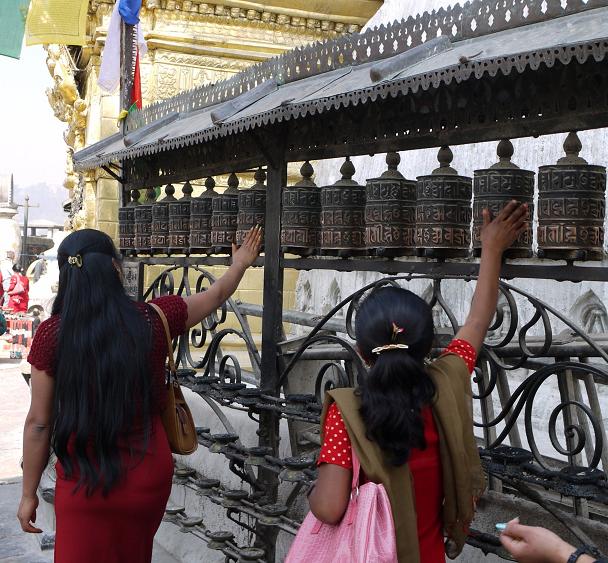
The hill is topped by a huge Buddhist stupa, which is an imposing white dome topped by the face of Buddha wearing a tall spire of a hat.  The question-mark shaped nose that is depicted in Nepal on Buddha’s face is the Nepali symbol for ek (one), and is a symbol of the unity of all life.  The base of the stupa is encircled by prayer wheels, on each one the Buddhist chant of Om Mani Padme Hum is written in Nepali.  All over Nepal, over and over again (including on the top of this hill), we heard the singing version of this chant pumping out of battery-operated boom box speakers.   I’m not certain, but it sure seems like Buddhism has only one song.

Behind the stupa, a huge crowd was gathered, some waiting in line to pay their respects at the shrine also sitting atop the hill that is dedicated to the Hindu goddess of smallpox, Hariti, who also doubles as a Buddhist deity.  For some reason, people also pray to Hariti for success on exams, so there were many families in line with school-age children.  Other people milled about near the open fires that were burning on the ground, or lighting the small butter votives as offering.  Monkeys hopped down from their perches on top of the stupa or temple to snatch bits of food, then hopped back up, clambering over the prayer wheels and stone carvings of deities.


Our next stop was an even larger Buddhist stupa called Bodhnath.  Our guidebook says it was first built at this spot near 600 A.D., after the Nepali king Songtsen Gampo was converted to Buddhism by his two wives; one the Nepali princess Bhrikuti, and the other a Chinese woman named Wencheng Konjo.  The big mounds of stupas were originally built to bury holy objects or people, and some believe that a piece of bone once belonging to the Buddha is interred at Bodhnath.

We lingered awhile at Bodhnath, enjoying the peace offered by the pedestrian-friendly (car and motorbike free) road that rings the base of the stupa.  From a rooftop cafĂ©, where we ordered fresh lemon sodas, we watched monks in cinnamon-colored robes mingle below with the tourists.  There are numerous Buddhist monasteries in the quiet lanes surrounding Bodhnath.


Our last destination of the day was the neighboring town of Patan.  Only 20 minutes away from Kathmandu by taxi, Patan was once a separate kingdom, and has its own Durbar Square (Palace Square).  Patan’s Durbar Square is intensely atmospheric, which much more architectural diversity than Kathmandu’s, and it’s more peaceful too, a good place to grab a shady spot and people watch.


A portion of the former palace was restored in the 1990s by an Austrian non-profit working with the Nepal government, and it houses a beautiful museum.  I especially enjoyed the old black and white photographs and etchings from the early 1700s and 1800s that depicted Patan when it was first “discovered” by westerners.  Eerily, the square today looks exactly as it did three hundred years ago; crumbling but still beautiful.  Even the style of Nepali dress favored by the old-timers hasn’t changed.

Mohit bought a dis- appointingly freezer- burned cup of ice cream, and while we sat in the shade I watched two little kids run up to a nut and popcorn vendor waving dirty rupee notes.  They each bought a cone of toasted nuts and then strolled away happily, talking to each other a mile a minute as they walked right down the middle of the street.  They couldn’t have been more than five years old, and I winced as motorbikes swerved to avoid them.


The next morning, our flight was delayed three times by the heavy brown smog that had settled in the valley; when we finally took off we both strained to see the mountains in the distance but the air pollution obscured everything more than fifty feet away.  But we finally spied dozens of snow-capped peaks framed by dazzling blue sky to the north after our plane rose above the cloud cover.  I hope that Nepal is able to sort out its political and economic challenges without compromising its stunning natural beauty and rich cultural history.


Monday, March 22, 2010

Kathmandu, Nepal

When we first landed in Kathmandu, we were surprised by the order and relative cleanliness of the streets.  We’re staying in the touristy Thamel neighborhood, surrounded by creature comforts like bakeries with fresh warm cinnamon buns, espresso machines, burrito cafes, Irish bars, live bands playing Bob Marley and the Beatles, and plentiful wifi internet.  The streets in Thamel are dust-free, and there’s no trash in the gutters, no animal dung to step over.  Not surprisingly, it turns out that this is definitely an artificial oasis of calm surrounded by the “real” Kathmandu, which we explored on foot on our first day back in the city after returning from our week in the mountains.

In fact, the real Kathmandu is quite possibly the dustiest, most chaotic city we’ve ever been in, and the old town looks more ancient and crumbling than anywhere I’ve ever seen.  I loved it!  Though dodging the motorbikes and rickshaws, navigating the crowds, and avoiding the women armed with brooms who were whipping up the dust on their thresholds into noxious clouds quickly sapped our energy.  We frequently ducked into alleyways or courtyards to momentarily evade the chaos.


The buildings in the old town look like they’ve been lived in for a thousand years- and some of them probably  have.  The stone walls are cracked and bowed and leaning precariously, and the ornate wooden balconies that were probably elegant at one time now look dangerously possible of crumbling.  And these buildings are all still energetically occupied, with bustling markets at the ground floors and laundry hanging from the old windows on the upper floors.  People must have been half as tall when these buildings were built, because the ancient rows of dilapidated old wooden doors that swing open at ground level to reveal dark caves of shops are about four feet tall; they look live shops for dwarves.  Or maybe hobbits.


We wandered into Kathmandu’s Durbar Square, the former seat of the city’s kings, where the royal palace is surrounded by a hodgepodge of tiered Hindu and Buddhist temples built mostly between 1100 and 1700.  In the unyielding midday sun (the blue of the sky turned white by the thick air pollution), we mingled with tourists from all over the world, though the tourists seem to be well outnumbered by the millions of pigeons.


I suspect the two dreadlocked men who sidled up to Mohit aren’t really holy men, and that they’ve donned their costumes for the rupees that they beg off tourists like us who take photographs of them.  After I snapped the photo, the taller one bumped fists with me, Obama-style.

The Nepali people seem to have a very casual relationship with religion.   In the shade of the thousand-year old temples in Durbar Square and on every street corner throughout the city, drunks lay sprawled out to sleep away the afternoon, and men gather to argue and gossip.  One of the temples we visited is dedicated to a Hindu god that also doubles as a Buddhist icon.  The street levels of many temples are occupied by shops selling mundane everyday goods like plastic buckets and shampoo; at others, the stairs are draped with pashmina shawls and yak wool blankets for sale.


And yet, people still pause as they pass  to honor the gods, putting their palms together, bowing their heads, reaching up to ring the brass bells, and scattering some red powder or marigold petals on the stone carvings of the gods.


I’m struggling to understand the complex political turmoil in this country.  The former prime minister Girija Prasad Koirala died on Saturday, and the whole city ground to a halt as a national holiday was declared.  From our taxi window, we could hear the roar of a crowd assembled in the cricket stadium, and I saw hundreds of people in line in a field nearby.  We learned later that they were all gathered to pay their respects to Koirala, who had been appointed, overthrown and reinstated multiple times during his long political career, spent time in prison, and then led the 2006 revolt to overthrow Nepal‘s former authoritarian king.  The men working at our hotel camped out in the lobby glued to the television all day and into the night, watching repetitive coverage of his life and last rites.

And yet we have been reading about the rampant corruption of government in Nepal.  As in India, bribery is common and expected.  We witnessed the strength of the challenging Maoist uprising in the neighboring city of Patan, where a throng of people marched through the streets waving flags bearing the symbol of socialism and shouting loudly.  When we were hiking through mountain villages, we saw Maoist graffiti on the stone walls of homes; apparently the Maoists draw their strength from the poorest villages of western Nepal, where rural people are fed up with being overlooked and cheated by the central government in Kathmandu.

This is a fascinating city, and a country of varied and beautiful geography.  But Nepal clearly has daunting political and social obstacles (the caste system remains strong here, and infant morality is third-highest in the world) to sort out before average quality of life can substantially improve.  Over dinner, Mohit and I debated and wondered how and why the west is so wealthy and so lucky in comparison to the poor luck of the draw for people in this part of the world.  Here, we’ve been forced to acknowledge how much we take for granted the most important things; stable democratic government, quality healthcare, and free education.


Sunday, March 21, 2010

Pausing for Reflection (and Missing Home)

We’re hanging out in Kathmandu for the next few days, and today we’re taking it slow, being lazy in cafes.  Reading books, researching our upcoming destinations, returning emails, doing laundry.  We’ve been away from home for almost three months now and I’ll admit- I’m feeling homesick today.  I wouldn’t trade this experience for anything- we feel so lucky and grateful to have the opportunity to see and do so much!  Yet, I did expect to miss home while being away for this long.  There are things I have been missing most:

- Clean laundry.  Our washer and dryer and clear, colorless water coming out of the faucet.  Clothes that smell like Tide detergent.

- Smoke-free bars and restaurants.  We really took these for granted back home.

- The warm yellow walls and sun-splashed hardwood floors of our condo.  Our cushy hand-me-down couch on a lazy Sunday morning, a big cup of French-press coffee in the hand-painted mug.   The treetop view out of the bay windows in our bedroom.

- Tory Row, this little bar in Harvard Square.  They serve the most delicious apricot-cheese spread with slices of hot toasty French bread and a little dish of spicy-sweet pickled cherry peppers.  Sitting near the window watching the world pass by on the sidewalk outside.

- Fresh produce.  Salads.  Strawberries and peaches and crunchy yellow peppers.  Goat cheese.  Greek yogurt.  All things uncooked and unpasteurized that we haven’t been able to eat while traveling.

- Our families.  Laughing over dinner with our friends.

- Consistent electricity.  Consistent hot water.  Clean floors. Clean feet.

- Silence.  No crowing roosters at sunrise, no barking dogs at night.  Walking down the street without someone desperately trying to sell me something.

Taking it slow today allows me the time to think about home, and to miss it.  The time also allows me to reflect on what we’re seeing.  Nepal is a very poor country, probably the poorest one that either of us has ever been to.  I’m reading “Three Cups of Tea” right now, and after hiking through the tiny mountain villages in western Nepal, I can easily imagine the not-so-far-from-here Pakistani mountain village that the book is about.  Many children here in Nepal have lives similar to the children in Pakistan, no roads, no bridges, no schools, unstable government.  Even in Kathmandu, if you ignore the isolated enclave of internet cafes in Thamel, sprung up out of the wealth of international tourist money, the rest of the city is easily hundreds of years behind our standard of life in America.  It’s sobering.  I feel guilty.  And lost.  I should be doing something to help, something to make a difference in the world.  But what?  How best to have a positive impact?

It’s precisely for moments like this, realizations like this, that I wanted to do this.  To see how the rest of the world lives.  To understand.  To learn.  To feel thankful.  To figure out how to give back.

Wednesday, March 17, 2010

Annapurna Mountains, Nepal

Day 1: Kathmandu to Rafting to Pohkara
As soon as we landed in Kathmandu, we popped in to several trekking agencies to make arrangements to head into the mountains.  We decided to head for Annapurna Base Camp, which will require eight days of mountain hiking about six hours each day, and will take us up to about 3500 meters in elevation.  On the way, we’ll stop today for some white water rafting.

Since it hasn’t rained much yet this season, the rapids were probably Class 3 to 3+, definitely not the 4 to 4+ we were hoping for, but lots of fun nonetheless.  We stopped for lunch at a bend in the river with a sandy beach.  At we sat eating our hard boiled eggs and bananas, a gaggle of boys came running down to the riverbank, just out of school for the afternoon.

They all stripped down to their underwear and gleefully hopped into the water, using our empty boat as a diving board and our lifejackets as floats.  After we reclaimed our stuff and just before we pushed off again into the river, our guide led the boys in an energetic rendition of the Nepalese national anthem.


Day 2: Pokhara to Nyapul to Tikedhunga
We stayed last night in Pokhara, in a room with a dribble of cold water for a shower.  We woke early, ate a hearty breakfast, then met up with our mustachioed trekking guide, Dambar and our skinny porter, Dipak.  We all loaded into a taxi with our backpacks for an hour ride to the base of the mountains at Nyapul.  The whole way up, our taxi driver played American 80’s easy listening: Belinda Carlisle, Bruce Springsteen, Heart.  It was a bumpy ride on hairpin turn roads that alternated from patchy asphalt to rocky, rutted dirt road, a game of chicken with the passing trucks and buses all the way up.


We hiked for four hours today, through tiny villages and past primitive stone farmhouses clinging to the side of the mountain.  In the afternoon, an enormous Golden Eagle soared over our heads, his broad wings longer from tip to tip than my outstretched arms.  His rust-brown body was immense, such a majestic and intimidating bird.  Dambar says the eagles sometimes snatch chickens from the villages.
Finally, arrival at the tiny mountain village of Tikenhunga- we made it!  That wasn’t so bad…only seven more days of hiking to go.  The lodge is more comfortable than we expected- and yet still spartan.  The walls are made of stacked stone from the mountains, and the rooms are separated by paper-thin plywood walls.  The floor is covered with a sheet of plastic and the room contains two narrow wood-frame beds, each with a thin foam mattress draped in a single white sheet (we‘ll stay warm in our rented sub-zero sleeping bags).  There is a shared squat toilet and a dripping cold water faucet.  There’s a bare light bulb in the wall above the window, but no electricity…


Day 3: Tikedhunga to Ulleri
We were supposed to trek for six hours today, climbing 1500 meters to Ghorepani.  But Mohit was awake all night with stomach cramps, and we think he’s sick from drinking purified water last night.  Up in the mountains, plastic bottles of water are scarce, since each one has to be lugged up by man or pony, and the waste plastic is a curse that can’t be buried or burned, so it will only accumulate. So we did the environmentally-friendly thing, like many other trekkers, and purified the mountain tap water with iodine drops.  I hadn’t finished my bottle of mineral water that we’d bought before leaving Pokhara, so I didn’t drink any purified water, but Mohit did, right before bedtime.


This morning we started up the mountain, since Mohit was optimistic that his discomfort would pass.  But as we started up the steep, endless rock steps, Mohit’s pain grew worse and we knew we couldn’t make it to Ghorepani.  We barely made it to a guesthouse in Ulleri, where Dambar secured us a rare lodge guestroom with an attached private squat toilet, and Mohit collapsed for a fitful nap.


While Mohit slept, I settled in on the sunny stone patio for an afternoon of reading, writing, and solitaire card games with a view over the mountains.  I’m sitting in a wooden chair painted bright blue and there’s a fluffy black puppy at my feet.  Five weeks old, he spends all day either sleeping or biting.  He bit my shoes and played tug-of-war with my shoelaces.


Day 4: Ulleri

Mohit woke up today, bitterly nauseous, with severe stomach cramps and more…poor guy.   We decided to stay put for the day, to give him time to rest and get better, and Mohit started a course of the antibiotics we brought with us.

While Mohit slept (or tried to) most of the day, I quietly observed a day in mountain village life.  Cobs of corn hung to dry from the rafters of a wooden porch.  A handful of dried corn scattered in the dirt for the chickens to peck at. A man crouches in his front yard splashing water from an aluminum bowl to wash his face.  Clanging bells hung from the necks of ponies trodding up the stone steps of the mountain, loaded with burlap sacks of supplies.

A woman wearing a scarf wrapped around her hair chases a herd of goats down the mountain.  The giggles of the guesthouse girls, free to sit and gossip now that the breakfast crowd has left and the lunchtime trekkers have yet to arrive.  The air is hazy with wood smoke.


I met a Tibetan seller of handicrafts.  Born in Pokhara to Tibetan parents, he now lives with his family in the mountains.  He says that making and selling beaded bracelets to the trekkers is a good job, better than the salary of about 1,050 rupees (about $15) per month that he’d make working for someone else.

At night, dozens of moths flap around the fluorescent lights in the dining room.  An old Nepalese man comes in with a plastic powdered milk bag tied to a stick, waving at the moths.  I see him and smile at his inability to catch any.  He meets my eyes and laughs and laughs, a huge toothy grin, deep sun-weathered wrinkles around his eyes.


Day 5: Ulleri to Ghorepani

Mohit felt marginally better and managed to eat some solid food this morning, so we decided to push ahead to Ghorepani.  Five straight hours of nothing but uphill all the way, I give Mohit tons of credit for sticking it out in his condition!

Today we walked through shady forests of pine and massive rhododendron trees.  The trees are all covered in moss and ghost-white orchids grow on some.  During the middle of the day it’s sunny and warm, but at 2800 meters in the afternoon, the air is crisp and windy.  The thermometer hanging on Mohit’s bag reads zero degrees Celsius just before the sun sets.
At night we warmed our fingers and toes in front of a makeshift woodstove, a 55-gallon metal drum vented through the roof and sitting on a block of concrete in the middle of the lodge.  We shared our dinner table with a Chinese-American man who lives in New York City, works for Major League Baseball, and who just completed two months of culinary school in China.  He’s traveling with his friend, a bushy-bearded father of three from Ohio who runs an organic farm.  They’ve just completed a week-long Habitat for Humanity build in Pokhara.  Outside, the weather grew colder and windier, and we all listened to huge chunks of hail pelt the metal roof over our heads.

Day 6: Ghorepani to Poon Hill to Tadapani
We started up the mountain in the pre-dawn darkness this morning, our flashlights illuminating white piles of hail from last night.  We stumbled over tree roots and rocks, and my heart beat so rapidly to compensate for the high altitude that I could hear the blood roar in my ears.

At 3210 meters, we topped Poon Hill just as the sun started to brighten the clouds, and the view was stunning.  For as long as we could stand the cold in our rented down jackets, we took in the panorama of the Annapurna mountain range, dominated by the peaks of Annapurna I (the 10th highest mountain in the world at more than 8000 meters tall) and Annapurna South.  The equally beautiful razor-sharp peak of Machapuchre (known locally as Fishtail) is a holy mountain to the Nepalese, and climbing to its peak is forbidden.


We headed back down to the Ghorepani lodge for a warm breakfast.  By 8 a.m. the sun was warming the air above freezing, and we struck back out towards Tadapani.  It was the toughest day of trekking by far, both because of the thinning air at this elevation, and also because the Nepalese seem to be firm believers in the adage that the shortest distance between two points is a straight line.  The trail took us straight up steep peaks, then straight back down.  Three times in a row, we climbed hundreds of meters and then back down.

Luckily, we were partially distracted from our wheezing breath and burning muscles by the riot of pinks and reds blooming in the rhododendron trees and the backdrop of snow-capped peaks against the sunny blue sky.  I couldn’t stop taking pictures, it was all so beautiful.


After five days and many courses of antibiotics and ameobicides, Mohit’s still feeling pretty awful, so we decided tonight to head down out of the mountains tomorrow.  Annapurna Base Camp will have to wait for next time.

Day 7: Tadapani to Nyapul to Pokhara
Ironically, Mohit woke FINALLY feeling much better, with a big appetite and barely any stomach pain.  It seems the medicines have finally kicked in.  No matter, we’d already made the decision to head down (and we’re being cautious in case he gets worse again).

We headed consistently downhill for seven solid hours today, through mossy rhodendron forests, over rickety bridges crossing streams heavy with the rain we’ve had the past few nights, and then through terraced farm fields at the lower elevations.  It turns out that going downhill, and not stumbling face-first onto the rocks, takes much more muscle power than climbing up, or so it seems when we finally reach the last check post at the bottom and collapse with exhaustion.

Along the way, we followed a man chasing a herd of donkeys down the mountain, their empty backs ready to be loaded up with provisions in Nyapul.  As he ran after them, he dropped his wallet and cigarettes.  We caught up with him along the way and it was nice to see his face relax with relief when we returned his wallet full of cash.
.

Day 8: Recovery in Pokhara
As I look through our photos today, I’m struck again by the beauty of the mountains and the simplicity of the villages we passed through.  Our pictures can’t do it all justice.  Go!  If you’ve ever considered trekking in Nepal- do it!  We already want to come back…

And if you do, you should contact our wonderful, patient, and experienced trekking guide Dambar Khadkar (guide_nepal @hotmail.com).  You’ll get a much better deal making arrangements with him directly than through a travel agency in Kathmandu.  Please tell him we recommended him, and help him put his two sons through college!  Jobs are scarce in Nepal.

And good news- Mohit’s finally better!  We’re both ready for more adventures back in Kathmandu and beyond…

Popular Posts

Search This Blog